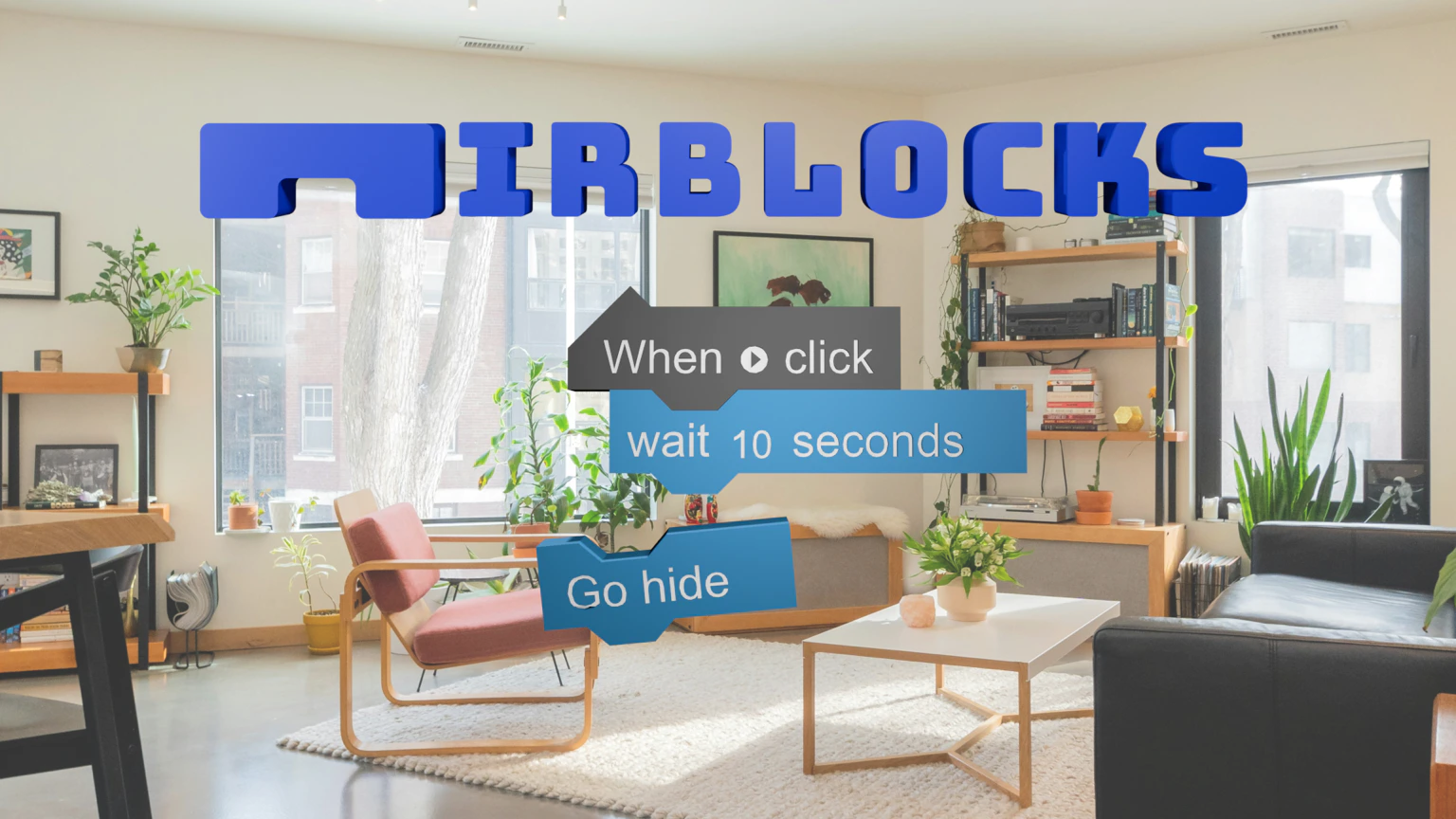
AirBlocks aims to take the visual, block-based coding concept into the spatial domain, allowing users to directly engage with logic and "be the hero" in their own learning process. It leverages mixed reality (MR) to provide an active, embodied learning experience.
The primary goal of AirBlocks is to provide an interactive, collaborative way to learn about computational thinking and introduce this concept through spatial learning. Users can connect 3D blocks to create interactive games, with blocks representing the smallest pieces of functionality, such as control, motion, manipulation, and looks.
The project drew inspiration from constructionist learning principles, emphasizing hands-on, experiential learning. While the concept itself is not new, we identified its potential when combined with XR technology. The Scratch programming language served as a source of reference, with its pioneering visual programming approach. With XR technology, we were able to expand the concept to the spatial domain, allowing for interactive, collaborative learning experiences. Research shows that utilising XR can lead to increased attention, satisfaction and confidence, further validating our approach (Khan et al., 2019). The decision to use mixed reality instead of virtual reality was driven by a lower entry barrier and the ability to naturally see the real-world environment and interact with it. It also allows for longer learning sessions, as there is no or less motion sickness involved. Additionally when collaborating with other users in the same room, users are able to see each other, allowing for natural interactions.
AirBlocks allows users to create their own logic programs by connecting blocks in a spatial environment. The blocks encompass various functionalities, including control (e.g., pressing start, wait for certain seconds), motion (e.g., walk for certain steps, turn around), manipulation (e.g., slow, speed up), and looks (e.g., change color). When connected, the character in the space immediately reacts to the changes, visualising the control flow built by the user.
AirBlocks was developed over 2.5 days during the MIT RealityHack XR Hackathon at the MIT Media Lab in Boston. It was selected as one of 12 finalists out of 100 projects and received an honourable mention.
More information: Devpost AirBlocks